 Frelixor
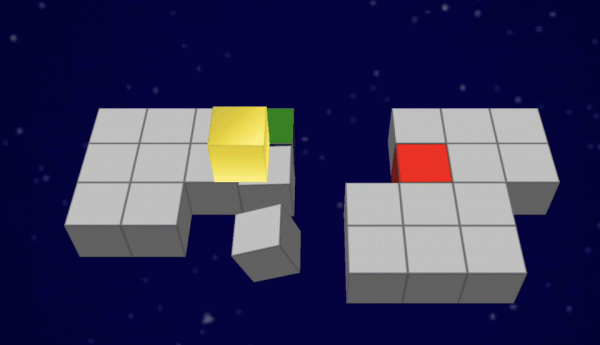
B-Cubed delivers a focused puzzle experience built on a single, well-explained rule: slide the gold cube to cover every square before reaching the red goal. The game avoids clutter, offering hints and instant restarts without undermining the challenge. Its progressive grids and obstacles keep the concept from growing stale. The main limitation is that the input does not describe additional modes or features beyond the core puzzle, so players seeking variety may find it narrow. Still, for those who enjoy spatial reasoning and patient planning, B-Cubed offers a satisfying and accessible challenge.
In B-Cubed, you control a gold cube that slides across a grid until it hits a wall or obstacle. The objective is twofold: step on every other square on the board, then finish on the red square. Because the cube cannot stop mid-slide, each drag—up, down, left, or right—commits you to a fixed path. This turns every move into a small spatial calculation: you must judge how far the cube will travel and where it will land relative to the remaining unvisited squares.
Early grids are small and forgiving, giving you room to experiment with the sliding rule. As you progress, boards grow larger and introduce obstacles that block movement and reshape the routes available. Each level has a unique arrangement, so you cannot rely on a single memorized pattern. The difficulty curve asks you to plan longer sequences of moves, and a wrong turn can leave squares unreachable, forcing a restart. This structure suits both newcomers and experienced puzzle players who want a steady increase in challenge.
B-Cubed uses a simple drag gesture with a mouse or touch screen. The cube responds immediately, and the interface stays clean with no timers or distracting elements. Hints are available for levels that stump you, though the game is designed to reward independent problem-solving. You can restart any level at any time, which keeps mistakes low-stakes and encourages experimentation. The control scheme works equally well on desktop and mobile, making it easy to pick up for short sessions or longer play.
Success in B-Cubed depends on thinking ahead. Before each move, consider which squares will become difficult to reach if you slide past them. Visualizing the full route—covering all required squares before landing on the red goal—is the central skill the game develops. Because the cube slides until it hits something, you often need to use walls and obstacles as stopping points rather than seeing them only as barriers. This layer of indirect control is what separates B-Cubed from simpler grid puzzles.
Sign in to comment
You must be logged in before posting a review or rating.
No comments yet. Be the first to comment!





Editorial Notes