 Frelixor
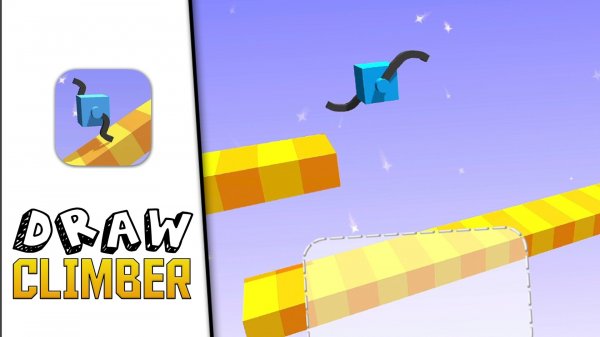
Draw Climber Creative Racing stands out by making the drawing pad the main control. Instead of steering, you sketch legs that determine movement, then redraw as terrain shifts between holes, steps, valleys, and peaks. The final launch adds a scoring layer beyond simply finishing first. It suits players who enjoy physics puzzles and quick experimentation, though those wanting direct control may find the indirect movement unusual. The family-friendly design keeps the challenge focused on creativity and timing.
In Draw Climber Creative Racing, you control a block character, but you never steer it directly. Instead, a drawing pad sits at the bottom of the screen, and you sketch the legs your block will use to move. The shape of those legs dictates how the block travels. A wheel-like curve rolls smoothly across flat ground, while claws or hooks bite into steep surfaces. Because the drawing pad stays available, you can redraw legs at any moment, which turns every course into a series of quick creative decisions rather than a fixed control scheme.
Courses are built from obstacles that punish a single leg design. Deep holes demand longer legs to span the distance, steep steps require gripping shapes, and tricky valleys and tall peaks force you to rethink your approach mid-race. The physics engine reacts to whatever you draw, so a leg that works on one section can fail on the next. You are not just racing an opponent; you are racing your own ability to adapt before the terrain changes again.
Adaptation is the core skill. When a flat stretch gives way to a wall, you erase and sketch a new leg shape while the race continues. Legs that are too long may get trimmed in tight spaces, so balance matters as much as creativity. The game rewards players who can visualize a shape, draw it quickly, and commit to it before the block reaches the next obstacle. That loop of draw, move, observe, and redraw keeps every attempt different.
Reaching the finish line first is only part of the goal. At the end of each race, a final burst of speed determines how far your block launches. Farther launches earn more points, so the last moments of a run carry their own risk-reward decision. You can play it safe and cross the line, or push for a bigger launch that boosts your score. Balancing that final gamble with the creativity needed throughout the course is what separates a good run from a great one.
Sign in to comment
You must be logged in before posting a review or rating.
No comments yet. Be the first to comment!



Editorial Notes