 Frelixor
Monochrome Maze Ball stands out for its commitment to minimalism and precision. The black-and-white presentation removes visual noise, forcing players to rely on spatial awareness and pattern recognition. Sensitive controls make each input meaningful, and the gradual difficulty curve builds confidence before layering on memory and dexterity challenges. It suits patient players who enjoy fine motor puzzles and quiet, focused sessions. The main limitation is that the experience is intentionally narrow: no color, no flash, just the puzzle. That focus is also its greatest strength.
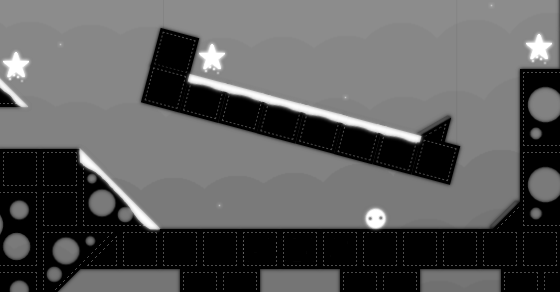
Monochrome Maze Ball removes color entirely. Environments are built from black and white contrasts, which pushes attention toward shapes, shadows, and the subtle cues tucked into the scenery. Clean lines and simple forms create a calm, almost meditative space. Without color to guide the eye, players must read spatial relationships and patterns to navigate each area. [IMG_1]
The central mechanic is guiding a small ball through carefully designed courses. Controls are intentionally sensitive: a slight nudge can send the ball rolling in an unexpected direction. That design turns simple navigation into a test of fine motor control and patience. Players learn to anticipate momentum and adjust their approach rather than reacting late. Every input counts, so success comes from measured adjustments instead of constant correction.
Each stage introduces new obstacles and pathways that encourage creative problem solving. The monochrome palette sometimes conceals important elements, forcing players to examine the environment from different angles. Early levels teach basic movement, while later stages combine multiple challenges that require both memory and dexterity. The difficulty curve is gradual, allowing players to build confidence before facing more complex arrangements. [IMG_2]
Success comes from a calm, methodical approach. Rushing often leads to mistakes, so studying each layout before moving helps. Experimenting with different routes can reveal hidden shortcuts or safer paths. Repeating tricky sections builds muscle memory, making precise movements feel more natural over time. The game rewards persistence and patience rather than speed.
Sign in to comment
You must be logged in before posting a review or rating.
No comments yet. Be the first to comment!









Editorial Notes