 Frelixor
Frelixor
Frelixor
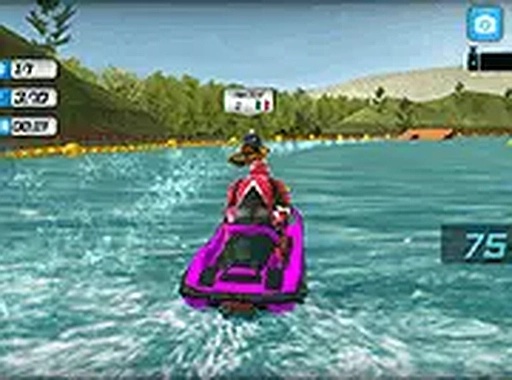
Jetstream Rider delivers a clean, challenging arcade concept: navigate a watercraft through a series of floating rings. The 3D visuals create a pleasant sense of speed, and the controls are responsive enough for fine adjustments. The progression system, where new courses unlock after completing previous ones, provides a clear goal. The main strength is its simplicity—no unnecessary mechanics, just pure precision driving. This makes it a good choice for players who enjoy skill-based challenges without complex rules. The difficulty ramps up steadily, ensuring that later courses remain engaging without becoming frustrating.
Jetstream Rider places players behind the handlebars of a nimble watercraft, tasked with navigating a series of floating rings suspended above the water. Each course presents a sequence of these rings, arranged along ramps and curves. The primary challenge is to steer the vehicle through every single ring without missing one. Missing a ring halts progress on that section, requiring a restart from the last checkpoint. This design emphasizes precision over pure speed, rewarding careful steering and course memorization.
The game employs a 3D graphical style with detailed water surfaces and dynamic lighting. The aquatic environment includes reflections and particle effects that create a sense of speed and immersion. Ramps are clearly visible against the sky, and the rings are highlighted to guide the player's path. The visual feedback is immediate: passing through a ring triggers a brief visual cue, confirming successful navigation. This clarity helps players focus on the task without confusion.
Players control their watercraft using standard keyboard inputs, typically the left and right arrow keys to steer. The controls are responsive, allowing for fine adjustments needed to align with each ring. The game is optimized for desktop browsers, with a full-screen mode available to minimize distractions. While the basic control is simple to grasp, mastering the timing and smooth steering required to complete later courses takes practice. This learning curve keeps the experience engaging without being overly complex.
As players successfully complete courses by passing through all rings, new courses become available. Each subsequent course introduces different ring placements and ramp configurations, demanding adaptation and improved skill. The difficulty gradually increases, encouraging players to refine their technique. This progression system provides a clear sense of achievement and motivates continued play. The variety in course layouts ensures that the gameplay remains fresh across multiple sessions.
To improve performance, focus on smooth, gradual steering inputs rather than sharp turns. Anticipate the position of upcoming rings by scanning ahead on the course. Taking a moment to learn the layout of a new course before attempting a fast run can reduce errors. Using full-screen mode helps maintain concentration. If a ring is missed, treat it as a learning opportunity rather than a failure. Regular practice builds the muscle memory needed to navigate courses efficiently.








Player Comments
Sign in to comment
You must be logged in before posting a review or rating.
No account? Create one
No comments yet. Be the first to comment!